 Live Chat Software


John Edward Jenkins
|
|
John Edward Jenkins, MD
Senior Vice President, Chief Clinical Officer, Connected Care Cone Health |
Neil C. Evans, M.D. is the Chief Officer for the Office of Connected Care in the Veterans Health Administration (VHA) within the U.S. Department of Veterans Affairs. He is board-certified in both Internal Medicine and Clinical Informatics. In addition to his executive leadership role in Clinical Informatics within VHA, Dr. Evans is an active clinician, managing a panel of patients in the Primary Care clinic at the Washington, D.C. Veterans Affairs Medical Center (VAMC).
Under Dr. Evans’ leadership, the Office of Connected Care is dedicated to improving services to Veterans, their families and Caregivers by increasing access, fostering continuity and promoting patient empowerment through digital health technologies. The Office of Connected Care manages VA’s expansive telehealth program, VA’s patient portal, My HealtheVet, the VA Mobile program, and VHA’s Innovation initiatives.
Along with the rest of the Office of Connected Care leadership team, Dr. Evans oversees the development and implementation of enterprise-wide Veteran digital health strategies, transforming care delivery across the care continuum and geography, and facilitating alignment of health information technologies within VHA to produce a consistent experience for users and continuously improve based on user input, research and evaluation.
Dr. Evans began his VA career after completing medical school at Johns Hopkins University and his subsequent training in Internal Medicine through the Osler Medical Residency, also at Johns Hopkins. He received a B.S. in chemical engineering from the University of Delaware. He holds a faculty appointment in Medicine at the Uniformed Services University of the Health Sciences.
In order to successfully integrate telehealth as a new paradigm in the health care landscape, it must add efficiency to the system as a whole. The key to best ensuring this added efficiency is to not simply replicate care over distance but add value by strategically targeting the highest cost patient populations in ways that both patients and providers are most likely to adopt the intervention. This presentation focuses on ways to avoid the common pitfall of using telehealth to increase utilization for utilization’s sake and how to best identify and strategically engage the most impeccable populations.
- Design programs to increase overall efficiency and cost effectiveness
- Discuss how to target and engage the right patients using population-based approaches such as school-based health programs and ACOs
- Utilize techniques that encourage both provider and patient engagement to ensure success

Medical Director, School Based Health and External Consultation
Medical University of South Carolina Center for Telehealth
Kathryn King Cristaldi
|
|
Kathryn King Cristaldi, MD, MHS
Medical Director, School Based Health and External Consultation Medical University of South Carolina Center for Telehealth |
Kathryn King Cristaldi, M.D., MHS, is the medical Director for School Based Health and External Consultation, Associate Program Director for the National Telehealth Center of Excellence, and an assistant professor in the Division of General Pediatrics at MUSC Children’s Hospital.
Dr. Cristaldi is a general pediatrician with a special interest implementing innovative programs targeted at extending the reach of primary care and preventative medicine to underserved populations. Hailing from a rural area herself, she has continuously sought out opportunities to form networks within her local community to support public health interventions. Beginning early in her pediatric training, Dr. Cristaldi was able to leverage community relationships to form a strong research partnership between the school district and the medical university in order to evaluate school-based health programs. She continued this partnership through her fellowship resulting in an AAP Young Investigator Award.
Following fellowship, Dr. Cristaldi accepted an appointment as the Medical Director for School-Based Health in the Center for Telehealth at MUSC. In this role directs the growth of, programmatic functioning, evaluation and the clinical care provided by other pediatricians, nurse practitioners and herself in approximately 80 school-based telehealth centers across South Carolina. In addition, as Director of External Consultation she directs a team of providers, administrators and information technology professionals who provide telehealth consultation to external entities and statewide partners. Most recently, she has been named the Associate Director of MUSC’s HRSA designated National Telehealth Center of Excellence. The Center of Excellence designation was awarded to MUSC as academic medical center with a history of both breadth and depth in telehealth programing. As a Center of Excellence MUSC will inform the national telehealth landscape through the following objectives 1) Analyize of the impact of telehealth on federal and local healthcare spending, 2) Detect key aspects of provider and patient engagement in telehealth and 3) Define and disseminate materials for implementation of an open access network.
In addition, she has helped form the South Carolina School-Based Health Collaborative, bringing providers from across the state together to examine best-practices for school-based health. She co-chairs the South Carolina Telehealth Alliance’s School-Based Telehealth Workgroup, forming a network of hospital systems, providers who collaborate together and with state agencies to implement school-based telehealth programs in areas of highest health and educational disparities. Dr. Cristaldi also serves as the representative from the AAP Section on Telehealth Care to the Pediatric Academic Society (PAS) Meeting Program Committee and has been asked to present at numerous national conferences to share her experience developing and implementing state-wide telehealth programs.
Dr. Cristaldi received her Bachelor of Science at the University of Dayton and earned her Medical Degree at the Medical College of Virginia at Virginia Commonwealth University. She completed her pediatric residency at MUSC, and an academic generalist fellowship at the Johns Hopkins University, earning a Master of Health Science degree from the Johns Hopkins Bloomberg School of Public Health.
Emerging voice technologies are creating a lot of buzz in terms of how they can be applied in health care, both in the home and in clinical settings. Through these technologies, patients and providers have the opportunity to rapidly and easily access health care information. But questions remain around issues of privacy, compliance, and how to ensure that providers and patients are engaged with and excited about these technologies.
- Learn how voice brings health assistance in the home
- Hear how to apply voice technologies in clinical settings to assist doctors in new and meaningful ways
- Demystify the clinician reticence to voice and learn about ways to mitigate concerns around the role of voice in health care

Partnerships Manager, Innovation and Digital Health Accelerator
Boston Children’s Hospital
Devin Nadar
|
|
Devin Nadar
Partnerships Manager, Innovation and Digital Health Accelerator Boston Children’s Hospital |
Providers need to shift their thinking from seeing virtual care as an additional service to being a standard option for providing care. There are key elements to successfully operationalizing a virtual visit program to ensure long-term adoption and scalability. In this case study, learn how Boston Children’s Hospital grew their virtual visit program to include 18 specialties, 140 providers, and 1,600 virtual visits in just one year’s time.
- Engage with department leadership to align strategic initiatives with clinical pain points to ensure scale and success
- Identify provider champions, key use cases, and outcome measures that are clinical and economic focused
- Implement a foundational framework to support all internal operations and external stakeholders around:
- Project planning
- Automated and guided scheduling and billing systems
- Training and support
- Patient and provider education and awareness
- Understand and address barriers to adoption and growth
- Develop relationship building for continued success and growth
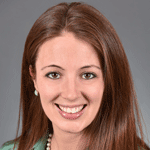
Senior Project Manager, Innovation and Digital Health Accelerator
Boston Children’s Hospital
Jackie Riso
|
|
Jackie Riso, MS
Senior Project Manager, Innovation and Digital Health Accelerator Boston Children’s Hospital |
Jackie Riso is a Senior Project Manager on the Innovation and Digital Health Accelerator team. Jackie is responsible for leading a range of short & long-term projects, implementing new initiatives and ensuring successful project completion. She manages our hospital to hospital telemedicine programs and virtual visit implementations across Boston Children’s Hospital. Jackie started her career at Boston Children’s in 2011, in Gastroenterology and Nutrition. She spent 3 years managing a variety of operations, such as patient care, supporting a team of 50 and coordinating medical rotations of Boston Children’s fellows along with visiting international Harvard Medical students. She then followed her passion for business operations and joined the Strategy and Network Development team in 2014. After completing her Master’s degree focused on the digital aspects of business, she was thrilled to follow her passion, help build, and become part of the Innovation and Digital Health Accelerator team in 2015.
Jackie completed her Master’s degree at Boston University in E-commerce, Systems, and Technology and a BS at Emmanuel College in Business Management, along with a minor in Information Technology.
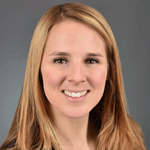
Program Coordinator, Innovation and Digital Health Accelerator
Boston Children’s Hospital
Caitlin Schumann
|
|
Caitlin Schumann, MPH
Program Coordinator, Innovation and Digital Health Accelerator Boston Children’s Hospital |
Caitlin Schumann is a program coordinator on the Innovation and Digital Health Accelerator team. Caitlin’s primary role has been launching and scaling the virtual visit program at Boston Children’s Hospital. She currently manages the technical operations, support and training for the virtual visit program, and is involved in developing other enterprise digital health programs and solutions. Caitlin’s interests and skills are in program development and operationalization.
Caitlin completed her BS in Nutrition and Dietetics and MPH concentrating in Health Policy and Management at UMass Amherst.
Blockchain promises the decentralized sharing of information without fear of hacking it. With all of the excitement around its potential in the health care field, wade through the buzz to find the real evidence and data on how to best leverage this technology in health care.
- Learn the basics behind blockchain to understand its potential application to health care
- Discuss how blockchain will change patient engagement and incentives for healthier behaviors
- Consider potential applications of blockchain to medical records

Roger Smith
|
|
Roger Smith, PhD
Chief Technology Officer Florida Hospital Nicholson Center |
Roger Smith, Ph.D., is currently the Chief Technology Officer for the Florida Hospital Nicholson Center where he is responsible for establishing the technology strategy and leading research experiments in robotic surgery, telesurgery, simulation-based education, and telehealth. He has served as the CTO for the U.S. Army PEO for Simulation, Training and Instrumentation (PEO-STRI); VP and CTO for training systems at Titan Corp; and Vice President of Technology at BTG Inc.
Roger holds a Ph.D. in Computer Science, a Doctorate in Management, an MBA, and an M.S. in Statistics. He has published 3 professional textbooks on simulation, 17 book chapters, and over 100 journal and conference papers. His most recent book is A CTO Thinks About Innovation. He has served on the editorial boards of the Transactions on Modeling and Computer Simulation and the Research Technology Management journals.
In order to get leadership and providers engaged in virtual health, you must be able to show them the data on how these programs improve service, cost, and quality. In this session, explore key quality metrics and how to track them to be able to tell a compelling story about your virtual health program.
- Capture user feedback to measure patient and provider satisfaction
- Examine where patients would have gone for care if not through virtual to be able to capture cost avoidance
- Discuss metrics to track to measure the quality of care being received through virtual care
- Explore how R OI differs in fee-for-service and value-based contracting

Director of Telemedicine
University of Virginia Karen S. Rheuban Center for Telehealth
David C. Cattell-Gordon
|
|
David C. Cattell-Gordon, MDiv, MSW
Director of Telemedicine University of Virginia Karen S. Rheuban Center for Telehealth |
David Cattell-Gordon is the Director of Telemedicine at the University of Virginia’s Karen S. Rheuban Center for Telehealth. He also serves as the Director of Rural Network for the UVA Health System. At the University, he teaches and serves on the faculty in Public Health Sciences and the School of Nursing. He has been involved with telemedicine since 1997, overseen telehealth initiatives at UVA since 2007 and been part of the team that lead UVA to have one of the nation’s leading programs.
The University of Virginia’s Center for Telehealth provides telehealth services in over 60 different specialties through a network of over 150 sites and supports broad-scale translational research through telehealth research initiatives. The Center operates the Mid-Atlantic Telehealth resource center serving 8 Mid-Atlantic States and the District of Columbia. UVA Telehealth has also launched pioneering programs in remote monitoring, pediatrics, cancer control, and global outreach. In 22 years the Center has spared the burden of travel for Virginians of over 17 million miles.
David, who was born and raised in the coalfields of Southeastern West Virginia, is a community organizer by training with advanced degrees in divinity and social work. David is also co-founder and senior advisor to The Healthy Appalachia Institute—a public health initiative-- at The University of Virginia’s College at Wise, located in Virginia’s coalfields. He is also co-founder of the Virginia Institute of Autism, an applied behavioral school, support program and research organization, and has published widely in the fields of autism, telemedicine as well as Appalachian culture.
David has received the Cisco Inaugural Telehealth Center of Excellence Award, The Virginia Governor’s Technology Award and the Doulas Wilder Excellence in Government Award. He is a member of the American Telemedicine Association, the National Association of Social Workers and a board member of the Mid-Atlantic Telehealth Resources Center and the Virginia Institute of Autism.
In recent years we’ve begun to see movement in policies surrounding telehealth and remote patient monitoring, creating new opportunities to expand programs and fund financial support. In this session, discuss what changes are on the horizon and what to expect in the next couple of years as your build your virtual health strategy.
- Discuss changes to expect from CMS on reimbursement for telehealth
- Hear what state and federal policies may impact your strategy in the short term
- Learn about advocacy efforts around greater reimbursement for telehealth services
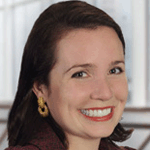
Cybil Roehrenbeck
|
|
Cybil Roehrenbeck
Shareholder Polsinelli |
Focusing on emerging health care sectors, Cybil Roehrenbeck helps clients achieve their objectives by employing a comprehensive, interdisciplinary approach to their legal and business challenges. She counsels clients on federal legislative and regulatory opportunities in the following areas:
- Health information technology
- mHealth and telehealth
- Precision medicine and genomics
- Innovative health care delivery models
- Coverage and reimbursement
She also provides counsel on perennial regulatory issues, including fraud and abuse (Stark and anti-kickback) compliance, competition matters, and audits.
Cybil’s prior experience includes serving as a lobbyist and attorney for the American Medical Association (AMA), legislative counsel to U.S. Representative Walter B. Jones (R-NC), and associate with Watts Partners, a government affairs firm led by U.S. Representative J.C. Watts, Jr. (R-OK).
Cybil works with clients to help them effectively present their values and challenges to Congress and federal regulators and obtain the best possible results for their businesses. She has had significant success in securing favorable amendments to federal legislation and regulation, including obtaining valuable informal guidance and feedback from federal regulators.

Natasa Sokolovich
|
|
Natasa Sokolovich, JD, MSHCP
Executive Director, Telehealth UPMC |
Natasa Sokolovich is currently Executive Director, Telehealth and Senior Director, Affiliated Physician Services, UPMC. UPMC, headquartered in Pittsburgh, Pennsylvania is a $16 billion global health care provider with over 80,000 employees, 30 hospitals and over 400 doctors’ offices and outpatient sites. UPMC also maintains its own health insurance services division with over 3.2 million members.
As Executive Director, Telehealth, Natasa is responsible for the strategic growth of UPMC’s Telehealth program. As a leading healthcare provider and insurer, UPMC is committed to implementing innovations in technology to develop new models of care that support the healthcare transition from a “volume to a value” based model. Through the ongoing expansion of multiple use cases and clinical services, the UPMC Telehealth program is ranked as a national leader, providing virtual clinical services to both UPMC and non-UPMC organizations.
The UPMC Telehealth program was launched in late 2006, with TeleStroke services and in 2008 services were expanded to include TelePsychiatry consults. UPMC’s TeleStroke & TelePsychiatry services currently span multiple locations throughout Pennsylvania, Northeastern Maryland and West Virginia and Minnesota, facilitating care to thousands of patients. UPMC Telehealth offers patients access to world-class clinical care closer to home. Visit volumes continue to exceed year over year, growth projections. In FY 2017 over 34,000 patients were treated via UPMC telemedicine services.
In 2012, UPMC expanded the hospital-based telemedicine services with a new model of out-patient care delivery through the launch of multiple, virtual multi-specialty clinics across various rural communities. These clinics are branded as UPMC Teleconsult Centers. The UPMC Teleconsult Centers provide patient access to over 35 virtual sub-Specialty services. Through this new virtual care model, patients have access to specialty clinical services which were previously not available within their communities. UPMC Teleconsult centers are available at five locations, with over 6,700 specialist visits completed through FY 2017.
In 2013, Natasa oversaw the launch of UPMC’s direct to consumer, on-line convenience care platform- UPMCAnywhereCare.com, providing 24/7/365 day/year, on-demand access to acute care diagnosis and treatment for patients with low acuity conditions. UPMC was one of the first healthcare organizations to launch its own on-line, convenience care platform, with integration to the system’s outpatient electronic health record and patient portal. In 2016, the UPMC AnywhereCare platform was further enhanced, offering additional consumer features and access through a native App, via a smart phone or mobile device. UPMC AnywhereCare services are provided by UPMC employed clinicians to patients across Pennsylvania, regardless of insurance coverage. Over 17,000 patients have successfully utilized UPMC AnywhereCare to receive care.
As Senior Director, Affiliated Physician Services, Natasa led the launch of a new suite of professional services called- UPMC Practice Solutions. UPMC Practice Solutions provides a menu of options which support private Practice Physicians. Services include: Electronic Health Record Solutions, Answering services, Transcription services and various other business solutions. The UPMC Practice Solutions program enrolled over 650 participating providers. In addition to the UPMC Practice Solutions program, Natasa led UPMC’s partnership with the Western Pennsylvania Regional Extension Center- “PA Reach West” (Federal Program through the Office of National Coordinator) as a sub recipient working to assist “preferred primary care providers” with adopting an Electronic Health Record and becoming “meaningful users” of this technology. Through the end of the program, UPMC contracted to assist over 750 providers throughout Western Pennsylvania.
Prior to joining UPMC, Natasa worked with several leading Pharmaceutical and Biotech Companies, including- Johnson & Johnson, Roche Laboratories and Enzon Pharmaceuticals, Inc. Her professional experience includes operations, sales and marketing, management and contracting, as well as strategic planning.
Natasa’s education includes a dual major, Bachelor of Science, Magna cum Laude degree from the University of Pittsburgh in Business and Psychology, as well as, a Masters in Healthcare Policy and Management from Carnegie Mellon University’s H. John Heinz III College. Natasa also holds a Juris Doctorate degree from the University of Pittsburgh School of Law and is licensed to practice Law in Pennsylvania. She is a member of the Pennsylvania Bar Association and the American Telemedicine Association, where she serves on the Business & Finance Special Interest Group. Born in Slovenia, Natasa is fluent in Serbo-Croatian.
Virtual health care programs offer are a key strategy organizations are using to aid in the transition from volume to value. Designing an effective dashboard that creates a comprehensive and integrated space to interact is critical in order to make the most of virtual health programs and manage a successful app.
- Explore how to pull everything you need from your EHR into a usable dashboard
- Learn how MedNow built their direct to consumer mobile app over a foundation of their patient portal
- Discuss what information you need to pull from your EHR and how to create the interoperability you need to succeed

Joseph Brennan
|
|
Joseph Brennan
Senior Director, MedNow Spectrum Health |
Joseph Brennan serves as the Senior Director of MedNow, the telehealth division of Spectrum Health, a 12-hospital, nonprofit health system based in Western Michigan. Since helping start MedNow in 2014, Joe has overseen the launch and scale of both MedNow’s Direct-to-Consumer primary care and specialty telemedicine services.
Joe has championed several pioneering components of Spectrum’s MedNow program, including a robust dashboard for outcomes analytics, a custom developed mobile app, and a digitally-driven, multimodal advertising strategy. He is also an active participant in industry events and has been honored for his commitment to community partnership. Joe was most recently named a Crain’s Detroit Business Health Care Hero for his work on patient access through the MedNow platform.
Prior to joining Spectrum Health MedNow, Joe served in various positions in technology and start-up entrepreneurship. He graduated from DePaul University with a Bachelor’s Degree in Business Leadership and is currently enrolled in the Stanford University Graduate School of Business LEAD Program.
In order to grow your virtual health program, you must achieve and maintain the buy-in from stakeholders across the continuum, from executive leadership through to the patient. In this session, learn how St. Luke’s Health System has built their virtual program focused on sustainability and achieved 95% provider satisfaction.
- Develop an e-governance committee to ensure leadership support and investment
- Create eHealth training programs to help providers succeed in virtual health and understand how it fits into the larger model of population health
- Learn how to meet patients where they’re at through the right technology to drive engagement and satisfaction
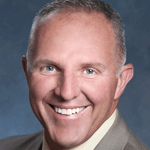
Steve Kropp
|
|
Steve Kropp, MS
System Director, Virtual Health St. Luke’s Health System |
Steve is the System Director of Virtual Health at Saint Luke’s Health System. He is responsible for the inception of the program in 1998 and the creation of virtual health care teams within each of the hospitals in the Saint Luke’s network. This includes strategic orchestration of clinical, administrative and technical components of their telehealth services. He has developed both inpatient and outpatient telemedicine programs in nearly all service lines provided in the Saint Luke’s Health System. He has orchestrated the necessary technology & providers to create access to a unique, sustainable model of telemedicine.
Steve served on the Missouri Governor’s Telemedicine subcommittee and HIT task force and is regularly engaged with Kansas & Missouri legislative issues impacting Telehealth and HIT. He served on a State subcommittee with the Board of Healing Arts to better define the practice of telemedicine in Missouri. He is a co-author of: a Telemedicine Toolkit in 2017 in conjunction with the American Health Information Management Association.
Virtual and augmented reality are transforming the way that health care is delivered to patients with a wide variety of medical and behavioral health disorders. Because VR/AR are available now on mobile platforms, it is possible to provide a continuum of care from traditional hospitals and clinics to the patient’s home. From treatment of specific phobias to PTSD, chronic pain management and relief from the stress of medical and surgical procedures, VR and AR are empowering patients to become active participants in their own health and well-being.
- Explore applications of VR and the impact it is having on pain and anxiety for patients
- Discuss what to consider in your organization to introduce VR in your suite of offerings

Brenda K. Wiederhold
|
|
Brenda K. Wiederhold, PhD, MBA, BCB, BCN
President Virtual Reality Medical Center |
Dr. Brenda K. Wiederhold, Ph.D., MBA, BCB, BCN is President of the Virtual Reality Medical Center (VRMC), with offices in Sorrento Valley, La Jolla and Coronado, California; Qingdao, China; and Brussels, Belgium. Professor Wiederhold is registered as a Licensed Clinical Psychologist with the California Board of Psychology and the Belgian Commission des Psychologues. Her doctorate is in Clinical Health Psychology, and she is Board Certified in both Biofeedback and Neurofeedback. She is Chief Executive Officer of the Interactive Media Institute, a 501c3 non-profit organization dedicated to furthering the application of advanced technologies for patient care; a Clinical Instructor in the Department of Psychiatry at UCSD; Medical Staff at Scripps Memorial Hospital in La Jolla and Co-chair Pain and Palliative Care Committee; a Visiting Professor at the Catholic University in Milan and an Advisory Board Member for the International Child Art Foundation in Washington, DC.
Founder of the international CyberPsychology, CyberTherapy, & Social Networking Conference (CYPSY), now celebrating its 23rd year, she also serves as Editor-in-Chief of the MedLine-indexed CyberPsychology, Behavior & Social Networking Journal (CYBER) published by Mary Ann Liebert Publishers in New York. She has over 300 scientific publications and is currently completing her 18th book. Recognized as an international leader in the treatment of stress-related disorders, burnout, pain and anxiety (panic, posttraumatic stress disorder and phobias) with Virtual Reality exposure, biofeedback and cognitive-behavioral therapy, in 1996 she conducted the first randomised controlled clinical trial using VR and biosensors to treat fear of flying. In 2006 she conducted the first randomised controlled clinical trial using VR to treat Iraq and Afghanistan war veterans suffering from PTSD. She has conducted over 10,000 VR therapy sessions and given invited lectures and training programs in 29 countries throughout Europe, North America, Asia and the Middle East.
Professor Wiederhold works to inform and educate policymakers, funding agencies, world leaders, the scientific community and general public about the transformative impact technology can have on healthcare. A U.S. citizen, Dr. Wiederhold has lived and worked in Asia, Switzerland, Austria and Belgium.
Hacking and cybersecurity are top of mind issues across all industries. In order to continue to expand digital strategies, health care organizations must be able to ensure the highest level of cyber security to protect the populations they serve.
- Discuss the key areas of security risk to ensure your organization is protected
- Hear the most common security concerns from the prospective of the organization and the patient
- Consider how patients perceive security as to best address their concerns
Senior Vice President and Chief Information Officer
Cook Children's Health Care System
Digital health care delivery creates opportunities to deliver high quality care while overcoming barriers created by issues of access, cost, stigma, the right provider fit. In this session, explore how Talkspace is changing the whole nature of care delivery to deliver the right care when, how, and where it’s needed.
- Expand the reach of behavioral health through digital health care
- Explore how text and audio messaging create opportunities for health care engagement through patient’s preferred method of communication
- Discuss the credentialing and training necessary to set providers up for success through text and audio messaging therapy
- Understand how messaging therapy is deemed effective behavioral therapy via published clinical research
Virtual health can be a valuable complement to value-based programs both in that it creates opportunities to engage patients in the home and creates a funding mechanism where reimbursement is still a challenge.
- Examine new payment and care delivery models to align incentives
- Learn how to integrate telehealth into bundled payment and global payment models
- Hear how to better support at-risk populations within ACO models

Ryan Blakey
|
|
Ryan Blakey
Senior Program Manager, Telehealth, Center for Population Health Partners HealthCare |
As Senior Program manager, Ryan leads the Telehealth strategies & programs at the Partners Healthcare’s Center for Population Health.
Ryan works closely with institutional stakeholders around design, development, implementation & the measurement for both synchronous and asynchronous Telehealth initiatives. He has over 7+ years working within Information Systems and Technology for Partners Healthcare systems. Prior to joining the Telehealth team, his focus had been primarily based within Ambulatory Quality & Improvement and Primary care workflow optimization implementation strategies for EHR integration. The role included identifying system solutions within an EHR to help ~215 Primary Care practice attain National Center for Quality Achievement (NCQA)’s certified Medical Home Recognition. In addition, Ryan lead a cross collaborative team on the design and build of an adult and pediatric Primary Care registry for use across Partners Healthcare.

Primary Care Physician, Medical Director Brigham Health Virtual Care
Associate Medical Director, Brigham and Women’s Physicians Organization Associate Medical Director, PHS Center for Population Health
Adam Licurse
|
|
Adam Licurse, MD, MHS
Primary Care Physician, Medical Director Brigham Health Virtual Care Associate Medical Director, Brigham and Women’s Physicians Organization Associate Medical Director, PHS Center for Population Health |
Adam Licurse, MD, MHS is an associate medical director at the Brigham and Women’s Physicians Organization, and an associate medical director at Partners Population Health Management. He practices primary care at the South Huntington primary care practice.
At Brigham Health, he leads a number of population health and care redesign efforts, including the Brigham’s virtual care and patient reported outcome measure (PROMs) programs. In his Partners Population Health Management role, he directs the strategy and implementation of the group's multiple patient engagement and telehealth programs, including efforts in shared decision making, in-office and virtual patient education, remote monitoring, patient texting, and virtual patient self-management. He has published multiple articles in his field, teaches local trainees and regional colleagues, and has been an invited speaker at numerous national conferences on population health, telehealth, and patient engagement. Adam completed residency training in Internal Medicine at BWH, and earned his MD and MHS at Yale School of Medicine where he graduated cum laude. He graduated from Yale College.